

The Science of Shine: Why Your Horse's Coat Looks Dull and How to Fix It
You’ve brushed for an hour. You’ve wiped over with a cloth. You step back… and the coat still looks dusty and flat.
This isn’t always a “you didn’t groom hard enough” problem. Most of the time, it’s a hair-structure problem.
In this article, we’ll break down what coat shine actually is (and why some horses look dull even when they’re clean), then translate it into the stable-yard fixes that create a true, structural shine—the kind that holds up tomorrow as well as it looks today.
What “shine” really is: the cuticle is the surface
Each hair shaft has three layers: the medulla (centre), the cortex (where the pigment sits), and the cuticle—the outer layer we actually touch when we groom.
The cuticle is made of overlapping keratin plates, like tiny roof tiles. They sit pointing from root to tip.
- When those plates lie flat, the surface becomes smooth and even.
- When they’re lifted (or packed with fine dust), the surface becomes uneven and grabby.
That cuticle surface is where shine is won or lost.
Why dull coats look dull (even when they’re clean)
Shine is basically a light-reflection issue.
- Flat cuticle plates = reflection. Light hits a smoother surface and bounces back in a more organised way. The eye reads that as shine.
- Lifted cuticle plates = scatter. Light hits uneven edges and bounces in all directions. The eye reads that as dullness.
Here’s the bit that matters in real life: a lifted cuticle doesn’t just scatter light—it also traps dust. So you can “clean” the horse, but if you leave the hair surface open and rough, it will look flat again fast.

Brushing direction: why “with the lay” is the real shortcut
The cuticle plates point from root to tip, so brushing direction matters more than most people realise.
Brushing against the lay (useful, but not a finishing step)
Brushing against the direction of coat growth lifts the plates. That can help with loosening deep dirt, dried sweat, and scurf—especially in winter coat, clip lines, or after turnout.
But if you finish there, you leave the hair surface slightly “open”. That means:
- it catches dust more easily
- it builds static more readily
- it looks dull sooner, so you have to do it all again tomorrow
Brushing with the lay (where shine actually happens)
Finishing strokes with the lay are what mechanically flatten those keratin plates back down. That’s what creates the smoother surface that reflects light, and it’s what helps the coat stay cleaner-looking between grooms.
Think of it as: deep clean to lift, then finish to seal.
The “dusty again” problem: it’s not just the stable
If your horse looks dusty again the moment they go back in, it’s often because the hair surface is acting like Velcro.
Lifted cuticle plates create microscopic edges that:
- catch fine dust and dander
- hold onto stable shavings
- build static when the coat is dry
A polished coat isn’t only prettier—it’s harder for dust to cling to, because there are fewer edges for particles to grab.
Eqclusive POV: different coats need different tools (and yes, colour is part of it)
We’re not interested in “one brush that does everything”. Coat shine is structural, and coat structure isn’t identical across horses.
As a rule, coat colour correlates with differences in hair diameter, density, and oil (sebum) rhythm. That changes how easily the coat:
- holds dust
- shows scurf
- builds static
- polishes up with finishing strokes
Bays & blacks: shine shows everything (including mistakes)
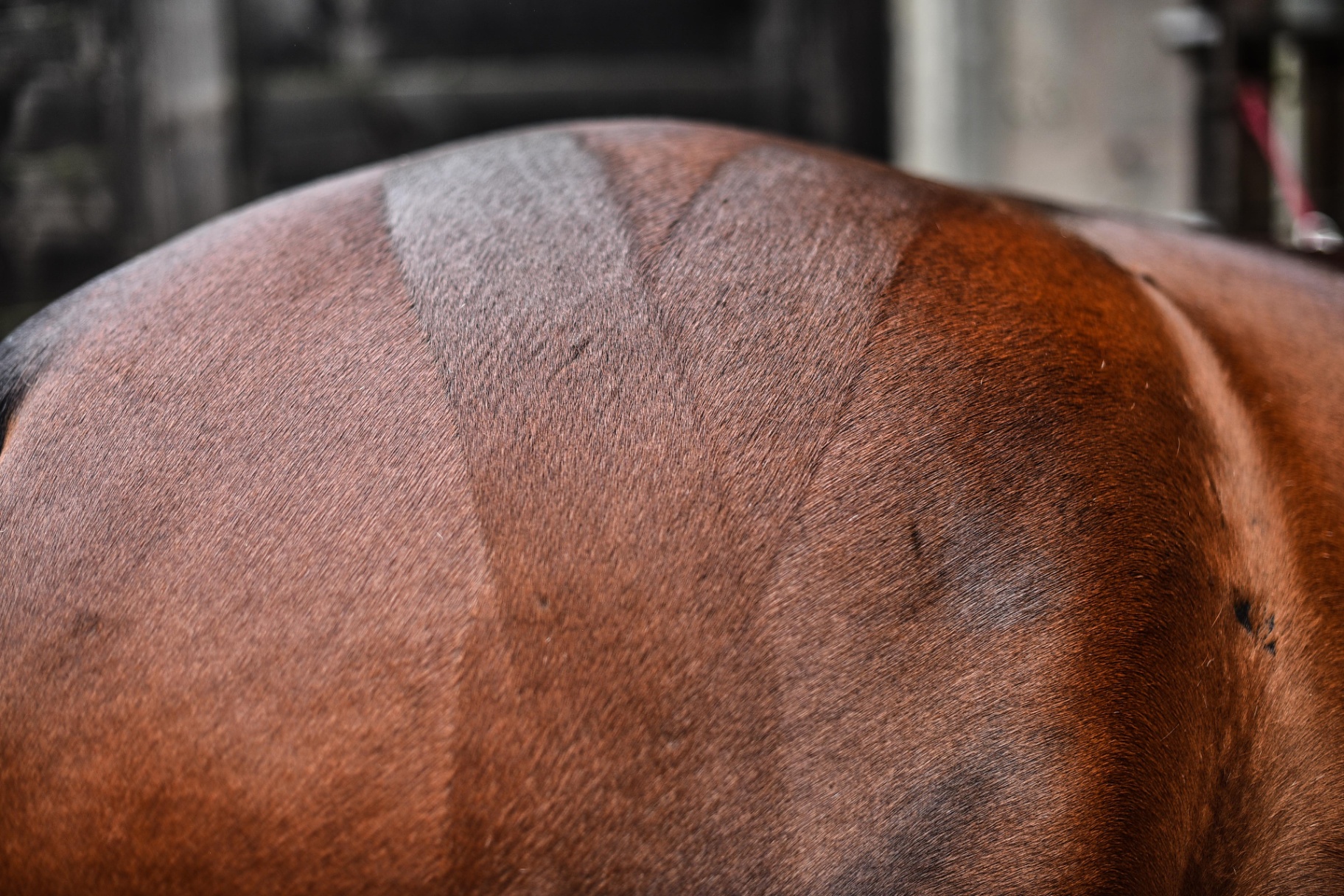
Dark coats tend to show disruption instantly—every dusty patch, every swirl, every bit of uneven oil distribution. The aim is effective cleaning without over-raising the cuticle, then a proper finish to lay the hair down smoothly.
Chestnuts: polishing without “greasy patches”
Chestnuts often need a balance: enough lift to remove fine dirt and dander, but a finish that distributes natural oils evenly so you don’t end up with dull areas beside heavier, oily-looking spots.
Greys & whites: keeping the cuticle closed helps with staining
Greys are notorious because once the hair surface is open, it doesn’t just collect dust—it holds onto stains. A good system is one that cleans thoroughly, then finishes in a way that keeps the hair lying flat and less grabby.
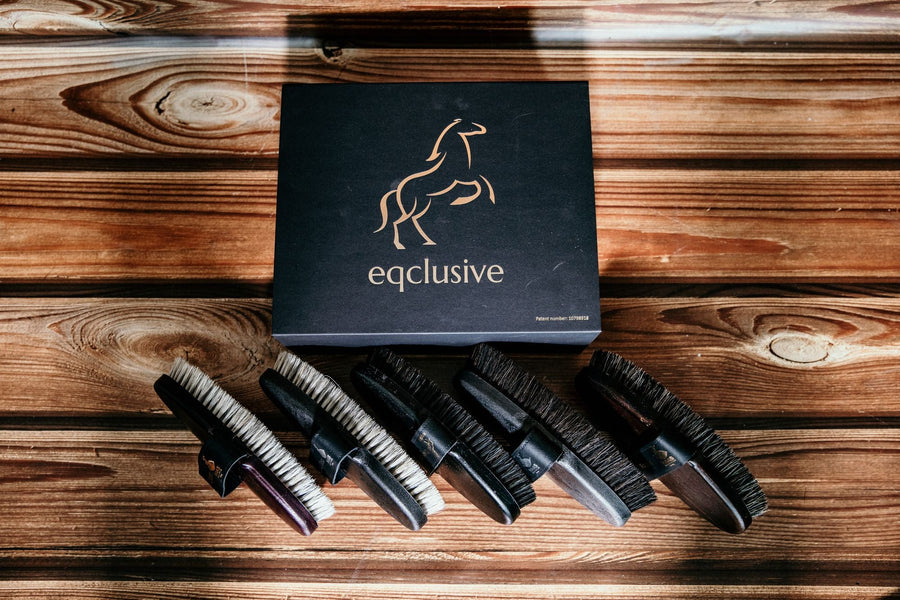
That’s why Eqclusive packs are coat-specific systems, not random brush bundles. The goal is the same—clean, sealed, reflective hair—but the route there isn’t identical for every horse.
If you want help choosing, start here: find the right pack for your horse’s coat type.
Sebum: The Natural Varnish
If the cuticle scales are the shingles, sebum is the varnish that coats them. Sebum is a complex mixture of lipids (fats), wax esters, and squalene produced by the sebaceous glands.
Its job is threefold:
- Waterproofing: It prevents the hair from becoming waterlogged.
- Antimicrobial: It forms part of the "acid mantle" that protects the skin from bacteria.
- Refraction: It fills in the microscopic gaps between the cuticle scales, creating a perfectly smooth surface for light to reflect off.
Traditional "shampoos" often act as degreasers, stripping this varnish away and leaving the cuticle shingles dry and brittle. This is why we advocate for the Eqclusive grooming method, which relies on mechanical cleaning with high-quality brushes to redistribute sebum rather than chemically removing it.
The Eqclusive Product Fit: Engineering a Better Shine
Most off-the-shelf brushes are designed with one-size-fits-all bristles: usually a medium-stiff synthetic. However, physics tells us that to move dust out and smooth a cuticle down, we need a graduated approach.
Our patented packs are curated to follow a scientific sequence:
- Step 1: The Foundation Clear. Removing the heavy "rubble" from the roof.
- Step 2: The Deep Clean. Reaching the skin to mobilise sebum and remove dander.
- Step 3: The Oil Distribution. Moving the sebum from the root to the tip of the hair.
- Step 4: The Cuticle Seal. The final polish that uses fine, natural bristles to lay the keratin plates flat.
By following this sequence, you aren't just "cleaning" the horse; you are performing a mechanical realignment of the hair's surface.
Summary: the shine you want is built into the hair surface
If your horse’s coat looks dull after a proper groom, don’t automatically blame the products or the effort. Look at what you’re leaving behind mechanically:
- Lifted cuticle plates scatter light and trap dust
- Finishing strokes with the lay flatten the plates, reduce static, and make the coat look cleaner for longer
- Coat type matters—hair diameter and oil rhythm change what tools and sequence work best
If you’d like the simplest next step, choose a system built for your horse’s coat: find the right pack for your horse’s coat type. For more science-led grooming guidance, visit our blog.
Leave a comment